


If you’ve looked into IVF costs in California, you’ve likely faced a moment of serious sticker shock, followed by a sinking feeling that this path to parenthood may be financially out of reach.
In 2026, the average cost of a single conventional IVF cycle in California ranges from $12,000 to $20,000, while an egg freezing cycle ranges from $8,000 to $14,000—and that’s just the starting point. Between medications costing $3,000–$7,000 and add-ons like genetic testing ($3,000–$5,000), the total can quickly climb to $30,000 or more.
But here’s what many patients don’t realize: affordable IVF and egg freezing does not mean lower-quality care. At West Coast Fertility Centers, we have built our entire mission around one core belief—that every patient deserves access to state-of-the-art fertility treatment, regardless of their budget. West Coast Fertility Centers offers IVF starting at $5,990 and Egg Freezing at $3,990 per cycle.
Here is the playbook on how we deliver high-quality IVF and egg freezing at prices designed to relieve financial stress, not add to it.
The Real Cost of IVF in California (And Why Transparency Matters)
Before we dive into solutions, let’s level-set on what you’re actually paying for in a standard IVF cycle. Most clinics in major metro areas like Los Angeles, San Francisco, Orange County and San Diego charge a base fee of $12,000 to $20,000 for the following core services:
Treatment planning
Ultrasound and blood work monitoring
Egg retrieval
Fertilization and embryo culture
Fresh embryo transfer
Pregnancy test
However, many patients are surprised to learn that the "base price" does not include critical components like pre-cycle testing, medications, anesthesia, ICSI, PGT or embryo storage—all of which can add thousands in separate fees.
This lack of transparency is precisely what we aim to eliminate at West Coast Fertility Centers.
How West Coast Fertility Centers Makes High-Quality IVF Affordable
1. Transparent Self-Pay Packages
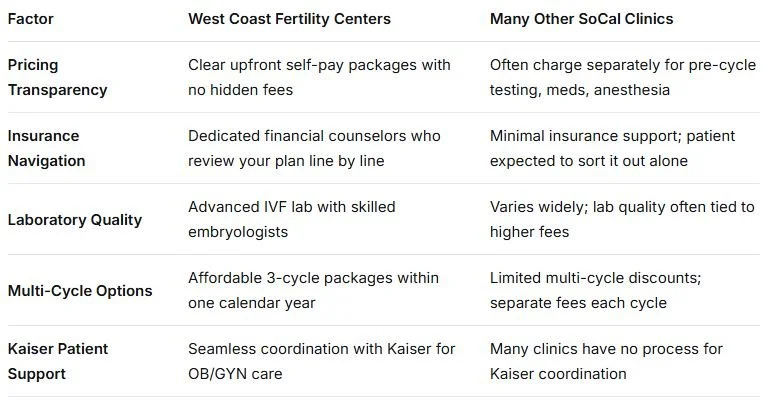
We believe you should never walk into a procedure wondering what the final bill will look like. That’s why West Coast Fertility Centers offers clear, upfront pricing for self-pay patients, with packages designed to reduce the financial uncertainty that comes with fertility treatment.
Our self-pay packages allow you to complete all necessary cycles within one calendar year at a fixed, predictable rate. This approach eliminates the anxiety of per-procedure billing and lets you focus entirely on what matters: your journey to parenthood.
For patients who choose to pay out-of-pocket rather than navigate complex insurance coverage, our financial counselors walk you through every line item so there are no hidden surprises.
2. In-Network with many PPO and HMO Insurance plans
Navigating insurance coverage for fertility can feel like a maze—but it’s one we help you solve. Our doctors are in-network with a wide range of insurance plans, meaning eligible patients may access fertility benefits at lower negotiated rates.
Special note for Kaiser Permanente patients: While Kaiser does not operate its own IVF laboratories in Southern California, West Coast Fertility Centers has extensive experience partnering with Kaiser patients. We offer our affordable self-pay rates while Kaiser continues to cover OB/GYN care, ovulation induction, and IUI at its facilities. Once pregnancy is established, we seamlessly coordinate the transfer of care back to Kaiser for prenatal and delivery services.
Our financial counselors are dedicated to helping you understand exactly what your plan covers—and what it doesn’t—before you commit to a single dollar.
3. Strategic Laboratory Excellence Without the Premium Markup
Many clinics in Orange County and Los Angeles charge a premium simply for having an on-site lab. At West Coast Fertility Centers, we treat our advanced IVF laboratory as a core necessity, not a luxury upcharge. Our labs are operated by highly skilled embryologists and andrologists using advanced technology—the same caliber of equipment found at top-tier academic centers.
By retaining 100% physician ownership and avoiding investors involvement in our surgery centers and IVF labs we are able to pass the savings on to our patients. Our physicians are mindful to carefully manage overhead and prioritize evidence based practices, allowing us to serve higher volume of patients while avoiding excessive markups.
4. Flexible Financing Partnerships We Vetted for You
We know that even with reduced rates, an IVF cycle represents a significant financial commitment. That’s why we’ve partnered with financial companies that specialize specifically in fertility loans.
Our financial counselors can help you explore specialized fertility financing (programs like Future Family, PatietFi and CapexMD offer loans with flexible terms and fast approvals).
Smart Strategies You Can Use Right Now
Check Your Insurance First — California’s New Law May Change Everything
As of January 1, 2026, California’s SB 729 requires large group health plans (employers with 101+ employees) to cover infertility diagnosis and treatment, including IVF. Up to three egg retrievals and unlimited embryo transfers are now mandated benefits for eligible plans.
If you work for a large employer, your plan may now cover a substantial portion of your IVF costs—including medications. Patients with coverage under SB 729 may see their out-of-pocket expenses drop from tens of thousands to just deductibles and co-pays.
Important exemption to know: Self-funded employer plans, small groups (100 or fewer employees), Medi-Cal, and religious organizations are not required to comply. If you’re unsure, your HR department can clarify your plan type.
Use Your Tax-Advantaged Dollars
Health Savings Accounts (HSAs) and Flexible Spending Accounts (FSAs) allow you to use pre-tax dollars for fertility-related expenses. For a couple in a 24% tax bracket, paying $10,000 in IVF costs through an HSA can save approximately $2,400 in taxes.
Ask About Multi-Cycle Discounts
Many patients require more than one cycle to achieve pregnancy. We encourage you to explore our 3-cyle-package bundles which can be significantly cheaper than paying per cycle individually.
What Sets West Coast Fertility Centers Apart?
Getting Started: Your First Steps to Affordable, High-Quality IVF
The most expensive IVF cycle is the one you never start because you were too overwhelmed by cost. Here’s how to begin:
Step 1: Call our financial counseling team. We’ll verify your insurance, explain self-pay options, and help you compare financing plans—all at no cost.
Step 2: Schedule a consultation. Meet with one of our fertility specialists to discuss your medical history, recommended treatment plan, and exact pricing based on your needs.
Step 3: Explore savings opportunities. Our counselors will help you identify grants, employer benefits, and financing programs you may qualify for before you pay a single cent.
The Bottom Line
High-quality IVF in California does not have to cost $30,000 or more. At West Coast Fertility Centers, we’ve worked hard to strip away unnecessary administrative costs, offer transparent pricing, accept a wide range of insurance plans, and partner with affordable financing programs—all while maintaining advanced IVF laboratories and a skilled clinical team.
Whether you have insurance through a large employer (possibly covered under SB 729), are a Kaiser patient needing IVF services, or are paying out-of-pocket, we invite you to see how affordable fertility care can be when affordability is part of a clinic’s mission, not an afterthought.
Your journey to parenthood shouldn’t be delayed by financial fear. Contact West Coast Fertility Centers today to take the first step toward growing your family.
Call or schedule a consultation online—our financial counselors are ready to help you navigate every option.
Disclaimer: This blog post is for informational purposes and does not constitute medical or financial advice. Coverage under SB 729 varies based on employer plan type, renewal dates, and individual circumstances. Please consult with your health plan provider and a licensed fertility specialist to determine your specific coverage and treatment options.